For the last two summers, I’ve spent a total of 17 weeks on the road on two massive roadtrips that tested my ability to balance the responsibilities of teaching two classes online and still find sufficient time to photograph, explore, relax, and have fun – all on the road and out the backside of my trusty FJ Cruiser. The two trips allowed me to check off all sorts of bucket list items while introducing me to new, favorite places I’ve never had the chance to explore in my life. I’ve been wanting to write something about what I learned during the last two roadtrips, to share some road wisdom if I found any at all, to try to make meaning of my experiences and, to finally mentally decompress from the trips. Offloading some of the bounty of realizations, memories, worries, failures and successes might bring some closure that I’ve found elusive. So, here goes nothing.
2024 Lower 48 Roadtrip in numbers, mileposts, and goals
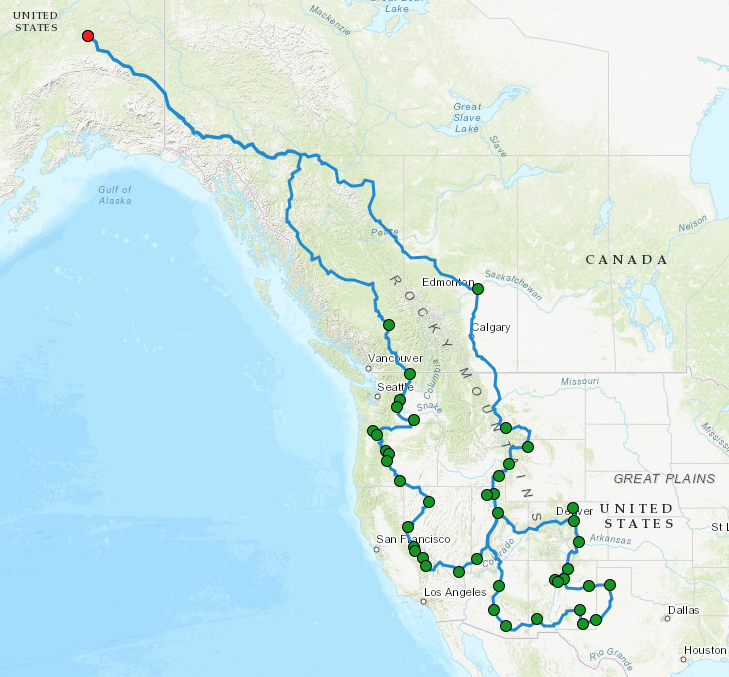
7.5 weeks. 13000 miles of travel. 13 states, two provinces, one territory. 880 digital photos, ~13 rolls of film. Seven Hot Springs.
- This trip, although not nearly as introspective, was in great part inspired by Travels with Charley by John Steinbeck. I had high hopes of reconnecting with people on a deeper level as Steinbeck had, and I wasn’t disappointed. I slowed down, I talked to strangers when it had seemed the the pandemic had taken all will away for being anonymously sociable. I listened more than I talked to strangers, allowing them to show me who they were. I traveled with a portable bar kit and a bottle of Yukon’s finest to share with folks I might meet on the road. In honor of this connection to Steinbeck, I finally found a name for my FJ Cruiser: Rocinante. Traveling along with me was a copy of Cervantes as well, but most folks assumed I was merely a fan of The Expanse.
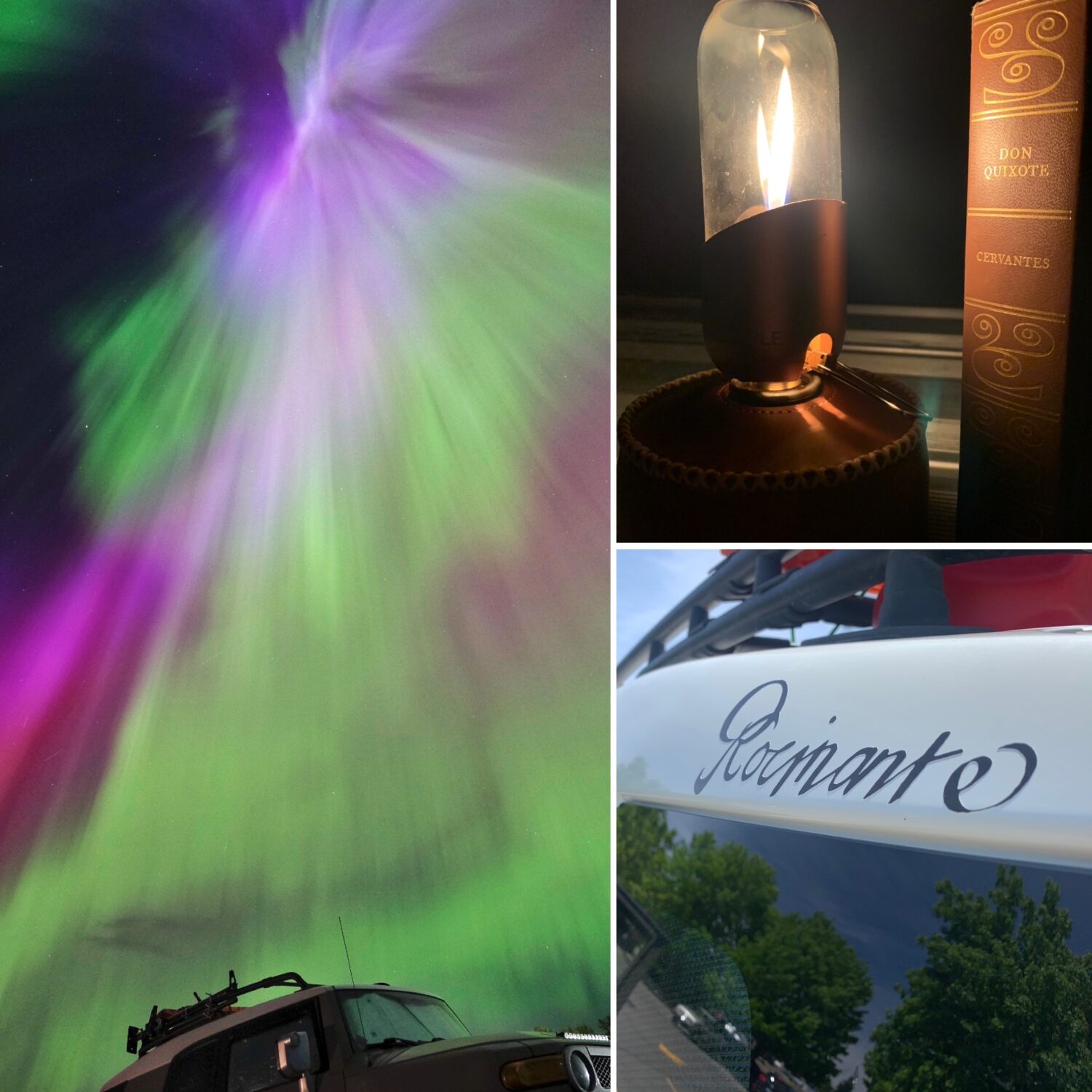
Clockwise from left: Auroral Burst at Fraser Lake, British Columbia, reading by lantern off Highway 37 in BC, Rocinante’s new vinyl nametag in Ellensburg, Washington. - The Cassiar Highway is one long stretch of nothing. 700 kilometers lacking many services, nearly any attractions, and certainly no cell coverage. Mileage signs suggest that towns exist along its path other than Dease Lake, but most signs merely give you distances to little more than highway maintenance sheds with no commercial services. Although I truly enjoyed exploring the ruins of Cassiar and the abandoned asbestos mine as well as an expansive wasteland created by a recent forest fire, the rest of the road was shrouded in early spring fog until I turned off toward Prince George. Perhaps the various dead-end roads to other communities might have something, but the main road is very lonely.
- This trip was defined by the hot springs that I dipped into. I struggle to condense thoughts to which was “best” because each had their own character. Bagby Hot Springs in Oregon was stunning with its slowly decaying CCC project buildings that were about to be reclaimed by nature – the wine barrel tubs were something else, too! Hart Mountain Hot Springs was reminiscent of the Brooks Range and paired with a free campground, it was perfect even though it was quite primitive – I think that’s what made it. Finding the remnants of an Elk carcass right outside one of the pools wasn’t off-putting at all. Wild Willy’s Hot Spring in the eastern Sierras was my least favorite – overcrowded and shallow. Probably 50-70 folks wading in ankle-deep water. I’ve been to Meadow Hot Springs in Utah three times and it never bores me – it was a great time and always is! There’s something about going down old roads in the middle of cow pastures to reach a random hole in the ground. I was lucky enough to share with my friend Greg what I affectionally call “Murder Hot Springs” – Spence Hot Springs outside of Jemez Springs in New Mexico. This time I did not think I was going to die from a serial killer. Last time? Not so much. Lava Hot Springs was the best commercial property hot springs I visited on my trip and I loved that each pond was slightly warmer than the last. And, finally – Laird Hot Springs in upper British Columbia – a must-stop on the Alaska Highway! Well-maintained, safe from bears, and in the middle of what can only be described as a tropical oasis in the middle of the near-Arctic, this place is spectacular.
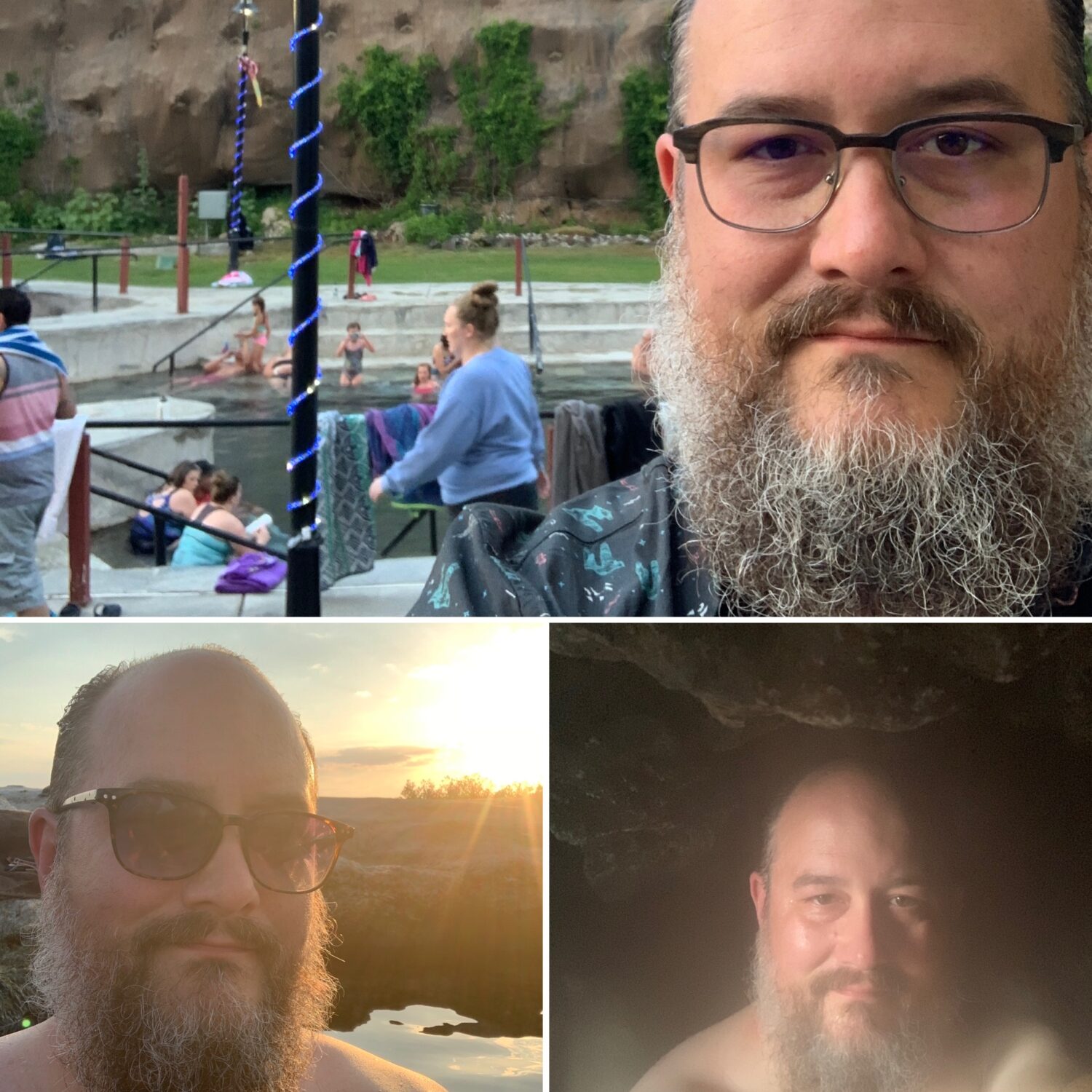
Clockwise from top: Lava Hot Springs, Idaho… Spence Hot Springs, New Mexico… Meadow Hot Springs, Utah. - This trip was chalk-full of bucket list check-offs. I toured Hanford’s Manhattan Project Park and its B-Reactor; a shockingly humbling experience to see the place where nuclear fuel was refined that killed nearly a hundred thousand people. Unlike so many there, I didn’t feel patriotic – I felt ashamed and disgusted. After 15 years or more of lusting after the well-preserved ghost town of Bodie from a far, I finally got to travel to this remote section of the eastern Sierras, spending 4+ hours talking with rangers, comparing local Fairbanks mining operations, and photographing everything that inspired me. Mono Lake and the pillars at Crowley Lake were next and didn’t disappoint – I started taking advantage of BLM public lands for camping by this point and truly enjoyed exploring these spaces. Getting out to the pillars in particular forced me to push my FJ more than I ever have before. The cinephile in me had to drop by the Alabama Hills and search out places where Tremors and Iron Man were filmed, but the real highlight was driving out in my own vehicle to Racetrack Playa and having the entire playa to myself at sunset. Although I spent a lot of time in national parks, visiting Dinosaur National Monument for the first time was a huge treat and let my inner childhood come out and parade about for quite a while. That said, my favorite new national park had to be Black Canyon of the Gunnison where I spent the night at the bottom of the chasm which rose approximately 2000 feet around me. When Greg joined me for a week on the road, we explored a stretch of Route 66 that I had never driven, hitting up Cadillac Ranch along the way. Visiting this roadside attraction wasn’t what I thought it would be – recent rains had flooded the field around the cars and folks were still letting their children play in the toxic sludge pond, full of half-empty spray cans and runoff from decades of spray paint on the cars. To be frank, it felt like a scene out of Idiocracy, complete with the kids wearing Crocs. My best time spent likely had to be the lengthy hike into Carlsbad Caverns with Greg – although I may have visited this site when I was very, very young, I have no memories left of that first time – and this time it was truly magical. Perhaps my last bucket list item was Heart Mountain Concentration Camp, and perhaps its a little strange that I had hoped so much to visit this destination. Heart Mountain represents the fourth internment camp I’ve visited after Manzanar, Minidoka, and Topaz. Unlike Manzanar, Heart Mountain’s interpretive center tries to play softball with the history, wasting precious space discussing why they call it a “relocation center” rather than concentration camps, prison camps, or internment camps – and it all boils down to how “uncomfortable” the locals are with calling it anything that doesn’t sound neutral and cheery.
- 880 digital photos doesn’t sound like much for a 7-week trip. For a lot of novice photographers, that sounds more like the product of a long weekend than any cross-country, 14,000-mile trek. I’ve always held dear the lessons I preach in my digital courses – that exercising and training your mind and hand to work with your camera efficently will increase quality and decrease quantity and that, in the end, shooting more means you have to pare down more, edit more, and scrutinize more. Be confident in your abilities and shoot with intention. Because of this, I don’t feel like I lost out on any photographs I wish that I took – I have the best that I could capture with the gear that I had. I felt comfortably prepared with a Fujifilm xPro-3 with a 27mm prime lens and a 16-80mm zoom. This was surprisingly freeing, compared to nearly a decade of shooting with a fixed 23mm lens on my primary digital cameras, an x100T and eventually a x100F. Given that I primarily shoot with prime and fixed lenses on my film cameras, it makes sense that I’d feel comfortable with this setup.
- ~13 Rolls of Film for a 7-week trip does feel a bit restrictive and it’s something I worked on rectifying during my 2025 trip. The majority of these rolls were 120 and only 12 exposures per roll, which is why I balk at that number. I started the trip with four main film cameras: a Rolleiflex T, Mamiya 7 with 50mm & 80mm lenses, Hasselblad 500 C/M with 80mm and 150mm lenses, and a Rolleiflex 3.5E. There’s a bunch of overlap in the capabilities of those cameras, but my Mamiya 7 is always on Infrared duty and I tend to shoot a variety of films – enough that the two A12 backs I have for my Hasselblad isn’t enough. The problem that I did run into with this is that I often had 4-5 rolls of film “going” at once and my hasty preps for some locations meant I didn’t note what roll was in which camera. This led to a lot of redone exposures after rolls were completed and I realized I over/under exposed the last two exposures or expected them to be shot on a different film stock. This is my ongoing problem: I don’t slow down enough to take the notes I know that I desperately need to take. It is a flaw I often point out to my students to try to drive home the importance of note-taking: if you don’t start it early, you’ll never do it. As for 35mm cameras, I brought my Rollei 35SE and a Nishika n8000 – the Rollei was used somewhat for street photography in Las Vegas, but the Nishika was unused. These problems led to several refinements to my 2025 trip.
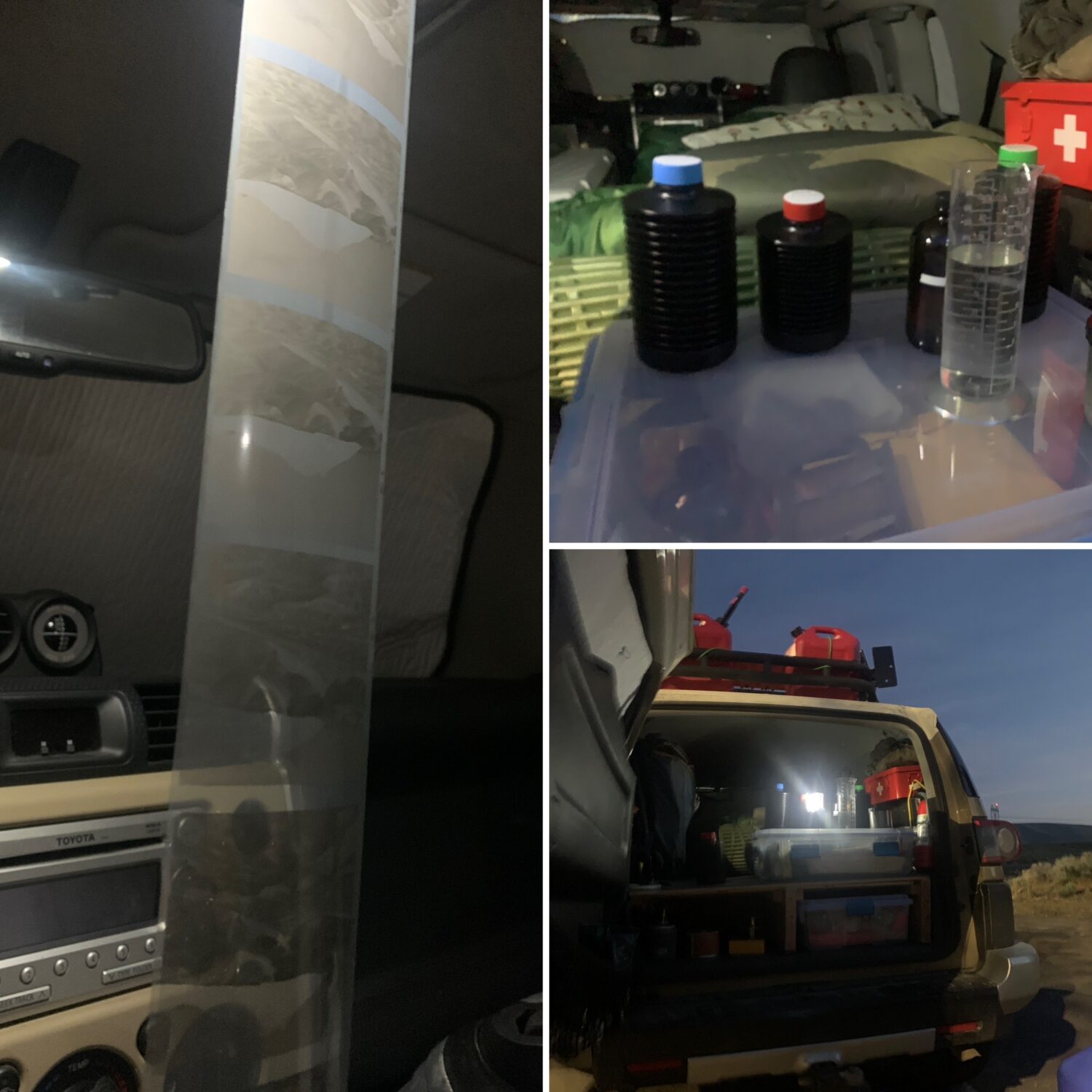
- Developing film remotely was a bigger hassle than I thought it would be. Although Rocinante was fully outfitted with a portable darkroom to develop and scan my 35mm and 120 film remotely without need for a darkroom, running water or wastewater collection, I quickly realized I had underestimated just how many containers I needed to capture waste material. While chemicals were certainly collected, waste rinse water was one that I initially did not consider and had to hastily make up for. After doing it remotely once, I decided my developing would be relegated to hotel rooms from now on. Even so, I had also failed to prepare a method to hang dry my film after processing and my MacGuyvering techniques left a lot to be desired. Scanning, however, was a much less stressful process because I had brought along a collapsible, cardboard Kodak Medium Format Scanner that I had recently purchased for my program to address students shooting film in the bush / remotely. Note that the link provided is for a 35mm one, the 120 version seems to have disappeared off Amazon; however: at $40 it is exactly the type of scanner you get for that price and was absolutely perfect for my need for portability – scans at 12 megapixel due to my phone’s limitations, but far more than needed for social media posts along the road.
- Inspired by Steinbeck’s desire to get to know the modern American in Travels after tumultuous years that made him feel alienated from the very people he wrote about, I, too, felt pretty disconnected from people after the pandemic and hoped to use this trip to reconnect. Although this trip was done during the summer of 2024, I still felt, in many ways, completely cut off due to the isolation caused by Covid and the increasing polarization of folks in the United States due to Trump’s toxic and divisive rhetoric. The stories that I’ve collected and folks I listened to during this trip have left an indelible mark on who I am going forward, hoping to be a more gentle, quiet person focused on listening rather than reacting.:
- My first reality check came when the bartender at a Brewery struck up conversation with me in Smithers, B.C., suggesting that a “photographer like me” must be super excited about the upcoming coronal burst that would send Aurora far, far south. I immediately launched into my regular lecture of being from Alaska, seeing it overdone, and not being interested in the least. They laughed, but, in retrospect, I wonder if it killed the conversation. That said, I was utterly humbled later on that night when the Auroral display grew over my head and, after hauitily refusing to be impressed earlier that day, I found myself spending 2-3 hours perfecting my exposures later that night camping at Fraser Lake. If I ever needed a bonk on my head to reset myself, to humble my arrogance, it was here.
- My next opportunity was at a quirky store outside of Keremeos, B.C., where a local artisan struck up a conversation with me. Clearly starving for conversation in an empty store, the discussion looped around where I was heading and where I had been initially, but the anti-5G posters outside the business should have clued me in on where the conversation was going. As innocent as a conversation about weather may seem, it led to how Alaskans had control of the weather anyways because of HAARP. I had expected this sort of paranoia from Americans, so hearing it from a Canadian was unexpected. I respectfully shifted the conversation by stating that I did know about HAARP and that my university was the one that operated it, and that we did not, at all, have any control over the weather, as Alaskans routinely have to contend with terrible weather. I found some trinket that I liked to buy and, looking back at it, she must have thought that my purchase was only made to quiet her opinions – in fact, she tried to convince me not to buy it after realizing I had more information than she did on the topic. I still bought the little statue, think of our conversation fondly because I didn’t turn tail and run at the anti-5G signs or the conspiracy-laden conversation – I engaged, informed, and left with both of us understanding each other and mutually respecting each other more than when I stepped in. It was refreshing.
- While taking a couple days slowly in Ellensburg, WA., I happened upon an amazing used bookstore – one of those that has random stacks that cling to the base of every shelf, that has some order to its organization based in a pedantic and possibly mystical methodology. I was enthralled. The owner, a quirky fellow a few years younger than I, popped out and made conversation about every book that I pulled out from the shelves. Wonderfully interactive, strangely nuanced, the conversation eventually evolved into one about the lack of respect and importance for books in modern society. The owner, who had sadly taken over the business recently from his father that passed on, was meticulous and organized among all of this chaos, but he was overwhelmingly preoccupied by shoplifters and went on an expansive rant on what was wrong with today’s youth. Using my background in Journalism and my studies in Media, I gently rebutted some of his more opinionated thoughts with alternative ways to read what was happening with his business and shoplifters. With every suggestion, he respectfully thanked me for my perspective and told me, with a genuine tone, that he’d have to think good and hard on this and incorporate what I said into his own thoughts. Quirky as he was, I couldn’t break away from the conversation because I genuinely wanted to keep it going. I spent over 45 minutes talking to him and 30 minutes backing out of his business, yet with each retort, I moved another two steps in to provide my own perspective. We were alone in this conversation for nearly an hour – not a single person came in to divert his attention. Much like the artisan, if this was me without Steinbeck guiding my voyage, I fear that I would have hastily dismissed both of them, refusing to find common ground. In contrast, what I did was listen, respect his ideas, discuss and support my arguments – and it was a wonderful experience. I can’t wait to go back.
- Because of my love of Mark Klett’s Third View project, I had hoped to photograph Pyramid Lake from the vantage point that he and those before him had. I headed into areas unknown when I crossed into Paiute Reservation, and while traveling around the lake, I saw an elderly couple seemingly stuck in the sand on the beach. Convinced they’d be fine, I continued down the road until my guilt got the best of me and I turned around about two miles later. Coming back, I quickly pulled off the road and pulled aside the little F-150 struggling in the sand. A woman of ~60 was struggling to dig out the back tires of the rear-wheel powered truck while a man of ~80 on a tank of Oxygen was desperately trying to get himself out in the driver’s seat. I offered help, grabbed by brand new grip pads from my roof rack and started trying to push and create enough traction to get the truck out, which was now up to its axels with sand. After 15 minutes of trying each way and chewing up my new grip pads quite a bit, I called it quits, made sure they had full coverage and asked them to call the local Vistor’s Center to get a tow. Profusely thankful for my failed attempt, the older gentleman started admonishing himself for being so foolish, which I was quick to deny, and I went back to Rocinante to pack up. Just then, a Beach Patrol vehicle (heh… beach patrol… in Nevada…) pulled up and two local indigenous park rangers got out offering help. It was clear the driver wasn’t having anything to do with it – I was quickly lumped into the idiots that got themselves stuck and therefore not worth helping, however I totally empathized with her position. After all, another know-nothing townie out here on their land that’s suddenly helpless and unprepared: it’s gotta be exhausting. The big bear of a man that got out of the passenger seat, however, was more than happy to help. Likely nearing 300lbs and 6’7’’, he towered over me but was the most jovial person I had seen in days. He quickly offered assistance, encouraged me to use my FJ to tow them out using gravity alone after encouraging me that I wouldn’t meet the same fate because I didn’t go into the sand with a 2-WD vehicle like… the folks I was helping. He went to lengths to assist me in removing the old boy’s assistive scooter that was attached to the back of his F-150, remove the rack it was sitting on, just so that we could get to the hitch. Did I mention it was hot? Anyways, 10 minutes later and I’m pulling them out of the sand, thanking the rangers profusely for their help, reset the old boy’s scooter and I’m saying my farewells when the old guy, a Korea War vet if I recall correctly, offers me profuse thanks and $100 bill for the help that wouldn’t have come were it not for the two rangers. I refused, asked him what I really did, and then to get him to accept help without payment, I thanked him for his service and asked him to pay it forward. I didn’t mention that I thought all thanks should go to the two rangers that came to their rescue; perhaps I should have. Walking back to my vehicle, the burly ranger followed me and I thanked him again for help well outside his job description, told him I planned to photograph from a specific point and he then said he was grateful that we ran into each other: that location was off-limits for anyone outside the tribe and I’d incur a hefty fine if I did. He followed that up by saying that he didn’t see any reason for me to get that fine, which sounded oddly unnecessary to say at the time. When I think about it now, I can’t help but think the subtext was that some folks did deserve that fine, but because I was friendly, respectful and willing to help someone in dire need, well, maybe I wasn’t too bad. I’ll take that as a win.
- Quickly following that up, I visited the Pyramid Lake Paiute Tribe Museum & Visitor’s Center and met someone that easily bested the jovial nature of the kindest ranger I had just met. One of the museum attendants, once finding out that I was from Alaska and that I was deeply interested in their local culture, followed me around the museum and provided a completely curated tour of the entire place while also sharing her own family’s connection to Alaska, her spiritual beliefs, and just doing everything possible to make me feel welcome. A deeply warm hug from a cherished grandmother or aunt is the only way I can describe how it felt like talking to her. I spent probably 4x longer in that museum than I would any other that size because of her. Dismayed that I didn’t have any money on me after recognizing the museum was donation-based, I ran back to my car after the hour or so I spent with her to contribute what I could before leaving. That entire day warmed by heart more than anything else on the trip, I believe.
Lovely stories. Cherished memories. Initially, I was very trepidatious toward being so open with strangers – but these experiences have warmed my heart and changed my perspective on our country. Maybe there’s something to this listening stuff; maybe being the vocal, being boisterous or being stoic isn’t what it’s cracked up to be. Maybe there’s hope for this country if we’d stop finding ways to divide each other, assume we know the strangers around us, and hate indiscriminately. But hasn’t modern life made listening so hard, in a world full of voices who only get listened to if they’re the loudest?
I could delay this post another week and still have things to share from this cherished trip, but I’d never be done with it. Here’s to hoping I’ll also get an accompanying post about my 2025 trip before it’s been 18 months since that trip!
+There are no comments
Add yours